

For today’s article, I’m moving away from the wines of Roero and Piemonte1 to introduce another side of Things in Bottles. A few weeks ago, I read Bodhi Landa’s article “Recoding orange wine,” arguing for the realigning of the term orange wine away from its current cultural connotations and baggage, back to a general term to describe the process/tradition of extended macerations of white grapes. On a similar “linguistics and orange wine” level, Simon J Woolf ’s “Don’t F***ing call it skin-contact” was another great article.
There are no historical references to Ludwig Wittgenstein being a fan of skin-contact orange wines. Indeed, most sources describe him as having a quasi-monastic approach to gastronomy. However, if he was still alive (and maybe even writing a substack), as a philosopher of language I’m sure he would have been interested in people trying to reject the meaning of a word being defined by its use in specific contexts rather than what it exactly refers to.
That is a rather arsey way to say that, aside from them being great articles, they are both arguing for a general restructuring of some of the language we use to describe certain wines. Landa thinks that orange wine has become too specific a term, lending itself to lazy use and misunderstanding, when really it should occupy a similar space as red, white, or rose, none of which carry as much baggage. Similarly, Woolf thinks skin-contact is incorrectly used as synonymous with orange on wine lists when the real definition of skin-contact would also include red and rosé.
Both articles, whether or not you agree with them, highlight a general linguistic deficiency that we have in English for describing such topics. So, whilst we’re at it, I’d also like to propose a term that needs rethinking/redefining or, as Landa puts it, Recoding.
The term in question is Cider.
Cider’s recoding needs to be quite an intensive surgery. Much needs to be removed, replaced, rejigged, moved around for the term to be of any use. I don’t think any of these actions will come from a single group of people, so the more that are aware, the better.
To show why I think cider needs recoding, let’s start off with a general outline of wine:
The product of a single, yearly, harvest of grapes, pressed and fermented. The conditions in that year leading up to that harvest dictate a large part of what the wine is like in that year. Beyond the grape variety, that after its planting can’t really be considered a “variable,” the rest of the deciding force of what that wine will be in that year is up to the people working at the winery/vineyard to decide how and what they are going to produce.
Now, let’s look at what the outline of cider would be if it has been recoded:
The product of a single, yearly, harvest of apples, pressed and fermented. The conditions in that year leading up to that harvest dictate a large part of what the cider is like in that year. Beyond the variety of apple, that after its planting can’t really be considered a “variable,” the rest of the deciding force of what that cider will be in that year is up to the people working at the cider/orchard to decide how and what they are going to produce.
Where’s the problem?
If you noticed the fact that my outline of cider is what it would be as opposed to what it is then it will come as no surprise that what I’ve outlined above is actually a far cry from where the legal definition of cider stands.
If you haven’t seen the below image printed out and blu tac’d onto the wall/window of a natural wine bar, it lists the authorised products that can go into wine depending on what certification (if any at all) it is made in accordance to:
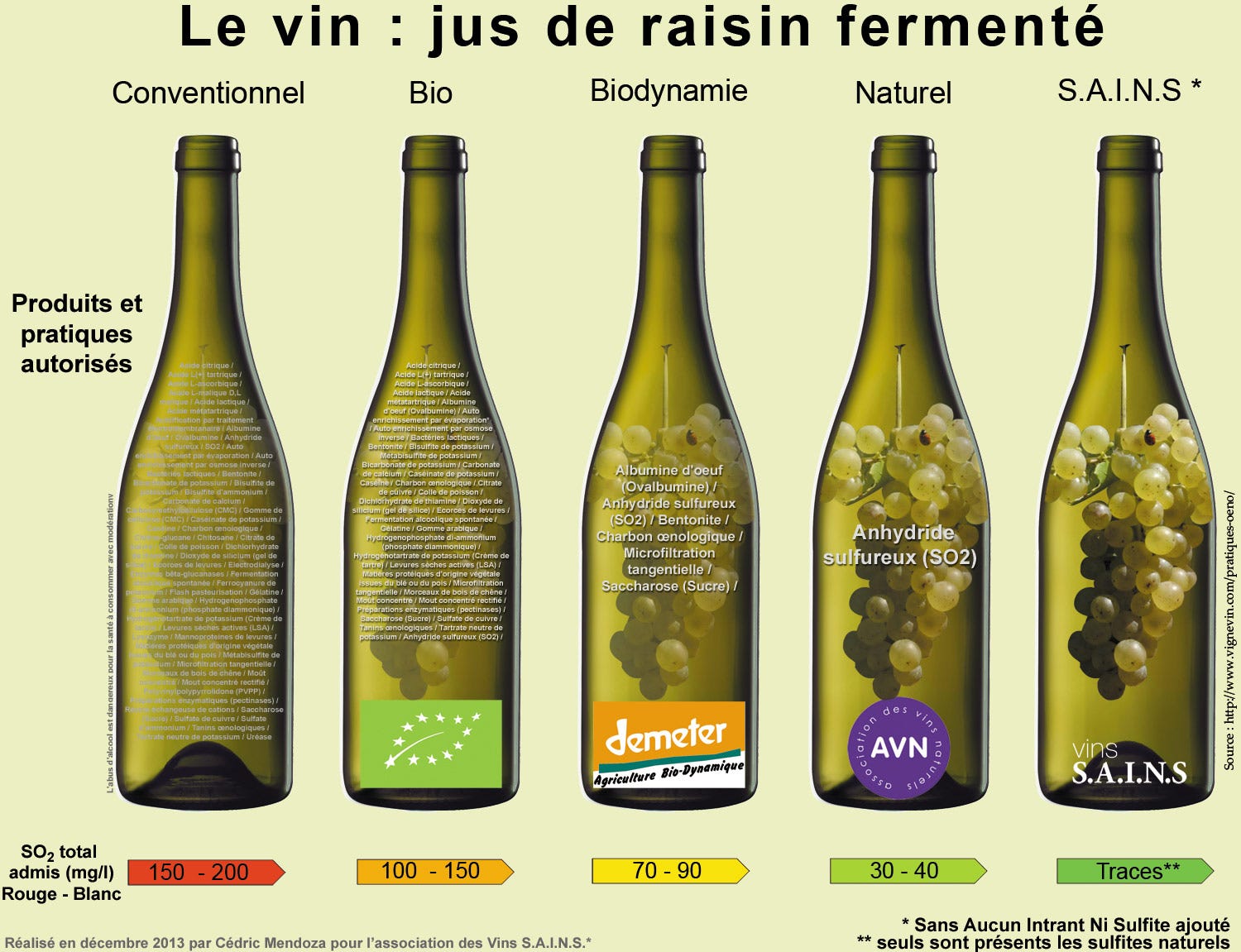
Some people, understandably, don’t like the idea of making wine by adding a bunch of stuff into it that isn’t grapes. Whether or not you are one of these people, I think you can still agree on one fundamental principle: even if you add whatever cocktail of additives to your wine, it should still be primarily made out of grapes.
Somehow in the cider world that message hasn’t got through. There would be a slightly easier, though still quite difficult, argument to make if the limit was at 50 or 51%, but it’s not. It’s
all
the
way
down
at 35%
And that isn’t even the last of it!
The 35% can all come from concentrate!
This means that since the law mandates only a starting sugar level of this “juice,” industrial producers can concentrate their juice and then add back in more water than they ever took out.
I’ll just write that in bold so that the people who skim read this articles still get the message:
For cider to be considered “cider” it only needs to contain 35% apple juice
Say it with me reader:
What the fuck is going on!
This is where the recoding needs to start. Increasing that 35% to even 50% or, dare I say it 51%, would be a step in the right direction. Thankfully, the wheels have already been set in motion for this, but my god have they been met with resistance.
The team at Redvers, a small producer in Herefordshire using only 100%, wrote to their MP, Ellie Chowns, last year to call for change. They argue that this low 35% threshold was damaging both to producers of 100% cider and also to traditional orchards - planted on standard rootstocks with canopies high enough to graze livestock underneath.
Ellie Chowns submitted a written question on raising the 35% limit to 50% and got this as a response from Dame Angela Eagle, the minister for food security and rural affairs:
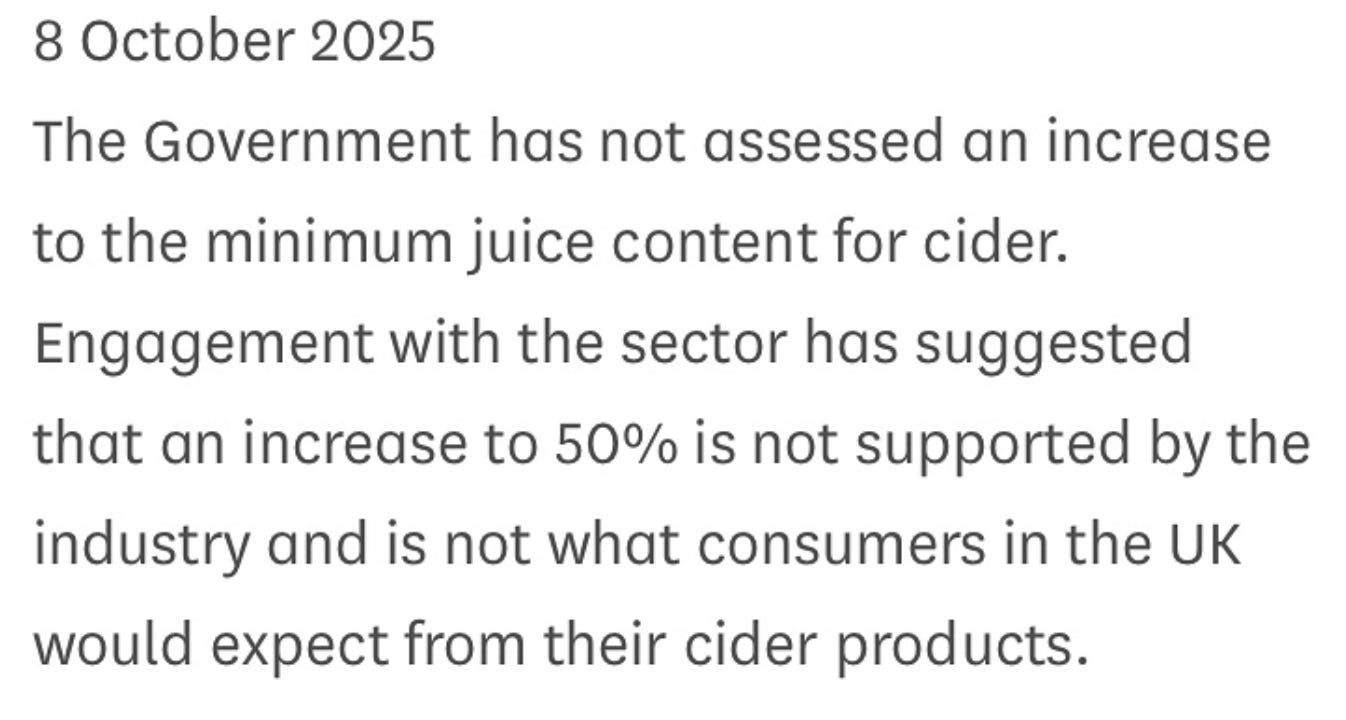
“Not what consumers in the UK would expect”
I’m aware that neither personal experience nor anecdotal experience are “consumer” experience, so I won’t pass them off as such. Instead, lets have a look at some cider advertising, which also relies on “consumer expectation”
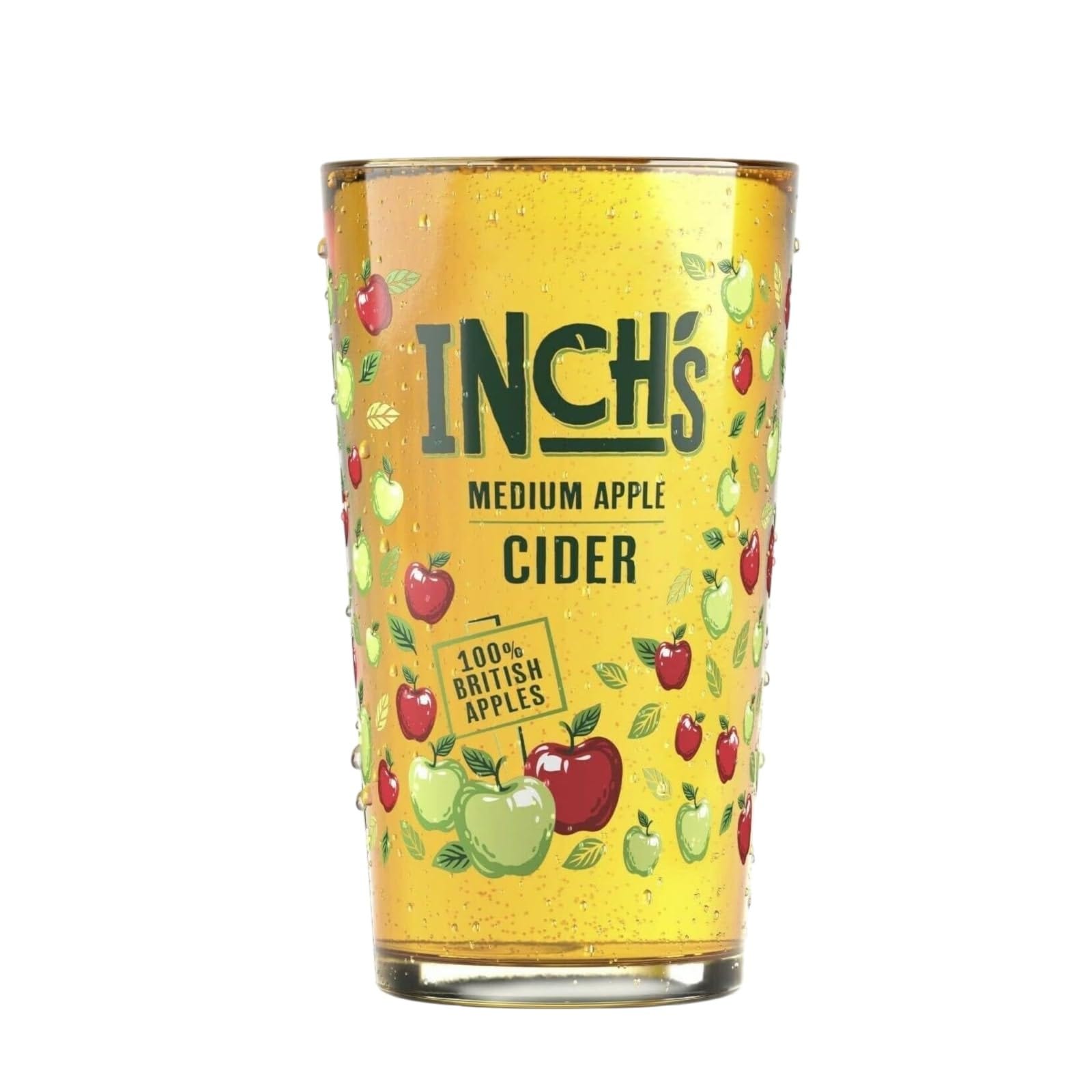
For £11.99 (shipping not included) you can buy yourself a Inch’s Cider pint glass on Amazon.
On the front of the glass, in very clear writing, outlined clearly so that all the “consumers” can see it, it says “100% British Apples”
As is customary in the UK, ingredients lists are written in order of how much of the product is made up of each ingredient. If, as they claim, Inch’s is “100% British Apples” the ingredients list should read as follows:
Apple Juice
Maybe some other bits and bobs like sulphites
And nothing else.
But it doesn’t. Instead, the ingredients list for Inch’s cider reads
Water
Apple juice
All the other bits and bobs like sulphites
How is this possible?
How can a product that is “100% British apples” contain more water than it does apples? What is the “consumer” supposed to “expect”?
“100% British apples” is a claim about Britishness and not about appleness
Heineken, the owner of Inch’s, doesn’t disclose the juice content of their cider.
I would nonetheless argue that writing “100% British Apples” surrounded by hundreds of apples and no Union Jack’s is playing on “consumer expectation” that the product is made of 100% apples and not that its 100% British.
Why should I care?
Another thing to make clear is that whilst the legal threshold is only 35% juice, there is still a strong collection of producers in the UK that stick to producing their ciders and their perries with 100% juice. The problem is that they have no legal protection above the 35% threshold.
I’m not arguing that a beverage made from 35% juice shouldn’t exist. I’m arguing that this beverage is in no way deserving of the title Cider. Call it something else instead like “alcoholic apple drink”.
To really answer the question of why should I care? there are thousands of answers. If you like drinking natural/authentic wines because you like drinking products that are born of people’s love of their land and their fermented craft then you should care about protecting these producers.
If you care about halting the normalisation of blanket pesticide use in agriculture then you should care. Where intensive orchards (the sort that Heineken felled 300 acres worth of a few years ago) need intensive spraying in order to manage diseases, traditional orchards are planted on standard rootstocks and grow to such a height that they support the grazing of livestock underneath them and need no spraying at all.
If you care about agricultural integrity, greenwashing, FARMWASHING, or British food sovereignty you should care. Alongside allowing all the apple juice to be concentrated in the production of “cider,” there is no required declaration of the origin of this apple juice concentrate. Plenty of the apple juice concentrate used for cider produced and sold in the UK comes from Eastern Europe. I have nothing against Eastern Europe or Eastern European apples, but if your whole brand image is centred on being British and cider’s inherent British symbolism, I want it to be grown in Britain!
Sure, it might seem like a fool’s errand to get caught up on this sort of thing, but when we stop caring about these things, we let down our guard on the rest of our food traditions. It is these food traditions, these traditional agricultural practices, ways of life, landscapes and economies that function as the connection between ourselves and our land. Without them, there is nothing stopping us from being anybody anywhere. As I have written before on here, when you enter into a British supermarket, you are neither in a time nor a place. Instead, you find yourself in a plastic wrapped selection of fruits and vegetables that are devoid of any seasonal or geographic changes, no matter where you go. Consuming anything that it is domestically produced, wherever you may live, is really what it means to be of a place; not just living in a place but living through a place in all its seasons and climates and traditions.
Further Reading:


Alcoholic Products Technical Guide Section 2.2 stating what is legally defined as “cider” and “Perry” in the UK
Cider Review in general – specifically this article by Adam Wells which is far more well mannered and less ranting in its demeanour
The Slow Cider Manifesto – written by Ian McFaul and Darlene Hayes, a far more thorough plan for what I have outlined in this article
The laughable response given by Dame Angela Eagle on raising the juice content from 35 to 50%
BBC news article about Heineken ripping up 300 acres of apple orchard – a headline that seemed to go relatively unnoticed compared to the felling of a single Sycamore that just so happened to be growing on Hadrian’s wall

Though will return once more articles have been researched and more wines have been tasted